149 million account data leak: what users need to know

The 149 million account data leak has raised serious concerns after a massive collection of login credentials was discovered exposed online. While social media posts amplified the alert quickly, understanding the data itself is far more important than reacting to headlines.
149 million account data leak explained
The exposed dataset reportedly contained nearly 150 million unique login records stored in an unprotected public database. The data was accessible without authentication, making it visible to anyone who knew where to look.
Security researchers noted that the dataset was not tied to a direct breach of companies like Gmail, Facebook, or Netflix. Instead, it appears to be a large scale aggregation of previously compromised credentials collected from older breaches, malware infections, and credential harvesting campaigns.
Key statistics from the exposed dataset
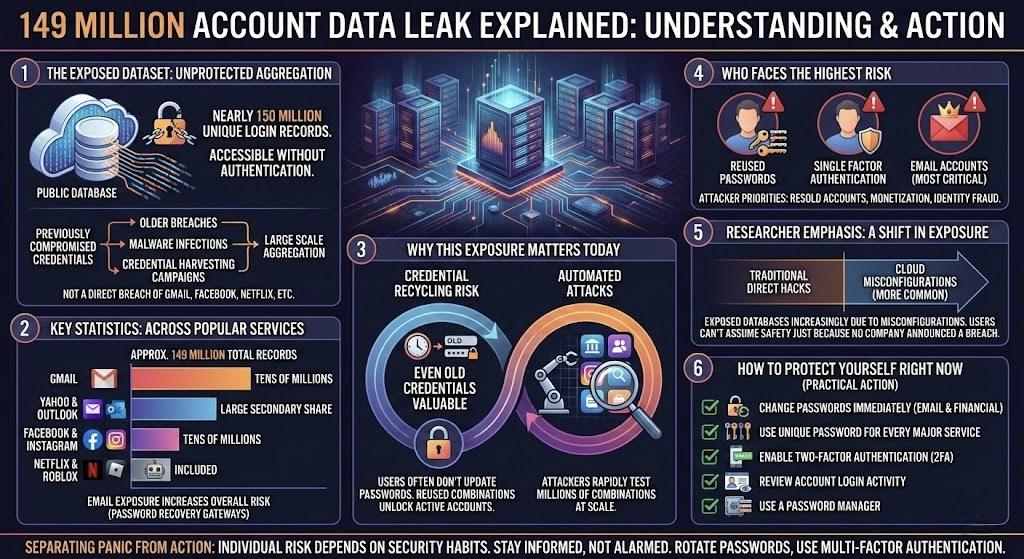
Analysis of the dataset shows how wide the exposure was across popular online services. Email accounts represented a major portion of the records, which significantly increases user risk.
- Roughly 149 million total login records were exposed
- Gmail accounts accounted for tens of millions of entries
- Yahoo and Outlook emails formed a large secondary share
- Platforms like Facebook and Instagram appeared in the tens of millions
- Services such as Netflix, Roblox, and dating apps were also included
Visual breakdown of exposed accounts
The following infographic provides a simplified visual overview of the affected platforms and account types based on the exposed dataset.
Why this exposure matters today
Even when credentials are not freshly stolen, they remain dangerous. Many users reuse passwords across services, allowing attackers to unlock multiple accounts using a single leaked combination.
Attackers commonly rely on automated credential testing. With datasets of this size, millions of login attempts can be executed rapidly against popular platforms.
Who is at the highest risk
Users who reuse passwords or have not enabled two factor authentication face the greatest danger. Email accounts are especially critical because they can be used to reset access to other services.
What you should do immediately
- Change passwords for email and financial accounts first
- Use unique passwords for every major platform
- Enable two factor authentication wherever possible
- Review login activity for unfamiliar access attempts
- Use a password manager to reduce reuse risks
Separating panic from practical action
Large data leak numbers often sound alarming, but real world risk depends on personal security habits. Users who maintain strong password hygiene and layered security are far less impacted by recycled breach data.
Staying informed and proactive remains the most effective response to incidents like the 149 million account data leak.